Phakic IOL / ICL

What is Phakic IOLS Procedure?
Phakic is an alternative to LASIK and PRK eye surgery for correcting moderate to severe myopia (nearsightedness), and in some cases produce better and more predictable vision outcomes than laser refractive surgery.
Phakic also known as implantable contact lenses (ICLs), are implantable contact lenses that are surgically inserted into the eye where they provide excellent quality of vision with predictable and stable results. The Evo Vision ICL is the latest phakic intraocular lens to receive approval from the FDA for a wide range of myopic (nearsightedness) correction needs. This technology is adapted from the proven lens technology used for cataract surgery, and works by placing the Visian ICL in front of the natural lens inside the eye. The Visian ICL is made of an advanced material that is extremely biocompatible and provides superior optical performance.
Step by Step Procedure
How Blade Lasik Is Performed

Step 1
The refractive lenticule and small incision are created inside the intact cornea all in one step

Step 2
Top layer lifted. Shape of cornea corrected using Excimer laser

Step 3
Flap replaced back on cornea.
We, at Medilaser, use the Moria SBK (Sub- Bowman’s keratomileusis) One-Use Plus microkeratome which can make thinner flaps (90 micron) than conventional microkeratomes. It has the advantage of leaving more corneal tissue behind for better long term corneal strength and stability. The conventional flap thickness (130 micron) option is also available with this device. We use the Carl Zeiss Refractive Suite ( Femtosecond laser on Visumax and Excimer laser Mel 80) for all our laser refractive procedures. The excimer laser uses an Ablation Smart Profile or Tissue Saving Profile to correct the refractive error with best results.

Femtosecond or Bladeless LASIK
◉ Predictability of flap thickness is better with femto-flaps i.e., a 100 micron femto-flap will be 100 micron whereas there can be variations with a microkeratome flap
◉ Predictability of flap diameter is better with femto made flaps
◉ Corneal size and curvature plays an important role in success of blade flaps while femto-flaps are independent of these variables. A steep or flat cornea can pose difficulty in flap creation with microkeratome/blade.
◉ Femtosecond flap making is a safer procedure with fewer complications (buttonhole, incomplete flap) as compared to blade LASIK.
◉ Femtosecond laser makes a vertical cut at the edge of the flap as opposed to the sloping edge of the blade flap.
◉ This results in better flap alignment and healing.
◉ Complications of epithelial cells growing under the flap edge are lesser in a femto-flap.
◉ Chances of flap displacement are lesser as the flap sits better.
◉ Femto laser makes planar, uniform flaps.
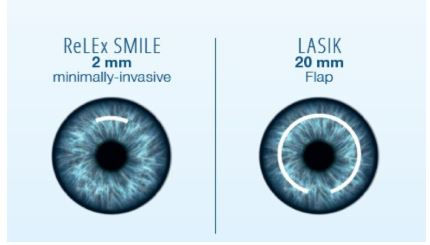
SMILE versus LASIK
◉ Flap complications like folds in the flap, displacement of the flap, buttonholes or complete cutting of the flap do not occur with SMILE
◉ The strength and structure of the cornea is preserved better with SMILE than with LASIK. The flap made in LASIK weakens the front of the cornea and cannot contribute to its strength in the future. A flapless procedure like SMILE is preferred for moderately high errors to provide better strength to the cornea in the longterm.
◉ Minimally invasive- 2 mm wound compared to 20 mm wound in LASIK. This results in more rapid recovery to routine activities
Procedure:
After the Procedure:
◉
Takes 15 minutes for both eyes together
◉
Numbing drops/ topical anesthesia used- no injection, no patch, no pain, no stitches, no blood
◉
One has to lie down for the duration of the procedure
◉
Eye is kept open and cannot be closed by the patient.
◉
While making the corneal flap, patient may sense some mild pressure on the eye and may experience a blackout in their vision for half a minute
◉
This sensation disappears after flap creation is complete
◉
Patient has to look at a fixation light when the excimer laser is fired
◉
Same procedure repeats for the other eye
◉
Goggles are given at the end of the procedure.
◉
Expect to see blurry and experience some watering, irritation on the day of treatment
◉
The day after, vision and comfort will be better
◉
Care to be taken while instilling drops to not disturb the flap
◉
No water in the eyes and head bath for 7-8 days
◉
Protective sunglasses outdoors for two weeks
◉
Side-effects: Dryness, glare, light sensitivity, night vision blurry. These are common and gradually get better over a few weeks.
These are common and gradually get better over few weeks.
Do's And Dont's
Before Surgery
◉ You should stop wearing soft contact lenses for 2 weeks before your initial evaluation.
◉ You should stop wearing rigid gas permeable (RGP) lenses for at least 3 weeks before your initial evaluation.
◉ You should stop wearing hard lenses for at least 4 weeks before your initial evaluation.
◉ The day before surgery, you should stop using creams, lotions, makeup, and perfumes.
Do's After Surgery
✔️ Connect with an ophthalmologist after the surgery for the first 6 months at regular intervals.
✔️ Take eye drops to avoid infections.
✔️ You may also be advised to use artificial tears to help lubricate the eye.
Dont's After Surgery
❌ Don't rub the eyes.
❌ Do not resume wearing contact lenses in the operated eye, even if your vision is blurry.
❌ Avoid swimming and using hot tubs or whirlpools for 1–2 months after the eye surgery.
❌ Protect your eye from any situation where it could be bumped.
❌ Avoid prolonged screen time or intense visual concentration.
Pros of Phakic IOLS

Painless

No injection

Can correct up to - 30D

No Dryness

Fast Recovery

Reversible Procedure